
Balance is More Than Standing on One Leg
Patti Abel | NOV 14, 2026
balance
strength training
bone health
nervous system
proprioception
Balance Is More Than Standing on One Leg
Understanding Your Nervous System, Proprioception & Fall Prevention
Balance isn't simply something we have or lose. It's a skill our bodies continually organize, practice, and adapt.
When people think about balance exercises, they often picture someone standing on one leg, perhaps trying not to wobble.
While that can certainly challenge balance, the process of maintaining stability is far more complex.
Our balance depends on an ongoing conversation between our sensory systems, nervous system, muscles, and joints.
And one of the things I find most fascinating is how much of that conversation happens without our conscious awareness.
Every time we walk across uneven ground, step off a curb, turn to look behind us, or reach for something overhead, our nervous system gathers information and makes adjustments.
These adjustments help us remain upright, coordinated, and responsive to our environment.
As we mature, maintaining this adaptability becomes especially important.

Balance Begins With Information
Our brains rely on several systems to understand where we are in space.
Three major contributors are:
1. The Visual System
Our eyes provide information about the environment, including distance, movement, and orientation.
Visual input helps us navigate obstacles and anticipate changes in our surroundings.
2. The Vestibular System
Located within the inner ear, the vestibular system detects head movement and helps us understand our orientation relative to gravity.
It contributes to maintaining balance, stabilizing our gaze, and coordinating movement.
3. The Somatosensory System
Sensory receptors in our skin, muscles, tendons, and joints provide information about pressure, position, and movement.
This includes proprioception, our ability to sense where different parts of our body are positioned without having to look at them.
Together, these systems provide the nervous system with the information needed to organize balance.
Our brains continually integrate that information and coordinate muscular responses.
This is why balance is so much more than having strong legs.
Balance is a whole-body process involving sensation, interpretation, and movement.
Our Feet Play an Important Role
Think about the last time you walked barefoot across grass or stepped onto an uneven surface.
You probably noticed that your feet responded to the changing ground beneath you.
Sensory receptors in the soles of our feet help detect pressure and changes in contact with the ground.
This information contributes to postural control.
Meanwhile, the muscles of our feet and ankles make adjustments to help manage our center of mass.
Our hips and trunk also participate.
If the ground shifts or our weight moves unexpectedly, the body must organize an appropriate response.
Sometimes that response occurs primarily around the ankles.
Other times, the hips become more involved.
And when necessary, we may take a step to regain stability.
These are coordinated strategies rather than isolated muscle actions.
This is one reason I enjoy integrating foot awareness, ankle mobility, hip strength, and standing movement into our work.
The feet provide information, the nervous system interprets it, and the body responds.
What Happens to Balance as We Age?
Aging can influence several systems involved in balance.
Changes may occur in:
Muscle strength and power
Sensory sensitivity
Vision
Vestibular function
Joint mobility
Reaction time
Confidence during movement
These changes don't happen at the same rate for everyone.
And importantly, many aspects of balance remain trainable throughout life.
We can improve strength, practice coordinated movement, and develop strategies for responding to different balance challenges.
But to improve balance, we need to practice balance.
Walking and general exercise offer many health benefits, but they may not provide enough challenge to significantly improve every aspect of postural control.
This is where intentional balance training becomes valuable.
What Does Research Tell Us About Fall Prevention?
A major Cochrane systematic review examined exercise programs designed to reduce falls among older adults living independently in the community.
The review included 108 randomized controlled trials involving more than 23,000 participants.
The researchers found that exercise programs reduced the overall rate of falls by approximately 23%.
Programs emphasizing balance and functional exercises were particularly effective.
Programs combining multiple exercise types, often including balance, functional movement, and resistance training, also demonstrated benefits.
These findings reinforce an important principle:
Balance improves when we challenge the systems responsible for maintaining it.
Simply strengthening muscles is not always enough.
We also need opportunities to practice coordination, weight transfer, postural adjustments, and functional movement.
Balance Training Should Be Progressive
One of the most common misunderstandings about balance training is that everyone should begin by standing on one leg without support.
For some people, that may be appropriate.
For others, it may create unnecessary fear or increase fall risk.
I prefer to think about balance as a progression.
We might begin by exploring how someone distributes weight through their feet.
Then we may practice shifting weight from side to side while maintaining support.
As strength and confidence develop, we can introduce more challenging positions and movements.
For example:
Weight Transfer
Moving weight from one foot to the other while maintaining awareness of the pelvis and trunk.
Changing the Base of Support
Progressing from a wider stance to a narrower stance when appropriate.
Standing Hip Strength
Challenging the muscles responsible for maintaining pelvic stability.
Reaching and Rotation
Learning to maintain balance while moving the arms and trunk.
Stepping Strategies
Practicing controlled steps in different directions.
Functional Challenges
Integrating balance into movements such as stepping over obstacles, turning, and changing direction.
The goal is not to eliminate every wobble.
Some degree of challenge is necessary for adaptation.
However, the environment should provide enough support to keep the activity safe.

The Nervous System and Movement Confidence
There is another aspect of balance that deserves attention.
Our sense of safety and confidence can influence how we move.
Someone who has experienced a fall may become more cautious.
They may shorten their steps, stiffen their body, or avoid certain activities.
These responses can be understandable attempts to protect themselves.
But excessive movement restriction may contribute to further reductions in strength and physical capacity.
This is where thoughtfully progressed movement experiences can help.
We can create opportunities for individuals to experience success while gradually expanding their abilities.
Through repetition, appropriate challenge, and supportive instruction, people can develop greater familiarity with movement.
As a nervous system integration facilitator, I find this relationship between sensory awareness, movement, and perceived safety especially meaningful.
We don't need to force the body into challenges it isn't prepared for.
But we also don't want to avoid every challenge.
We want to develop the ability to respond, adapt, and recover.
How We Explore Balance at Abel Wellness
Balance work doesn't always look like traditional balance exercises.
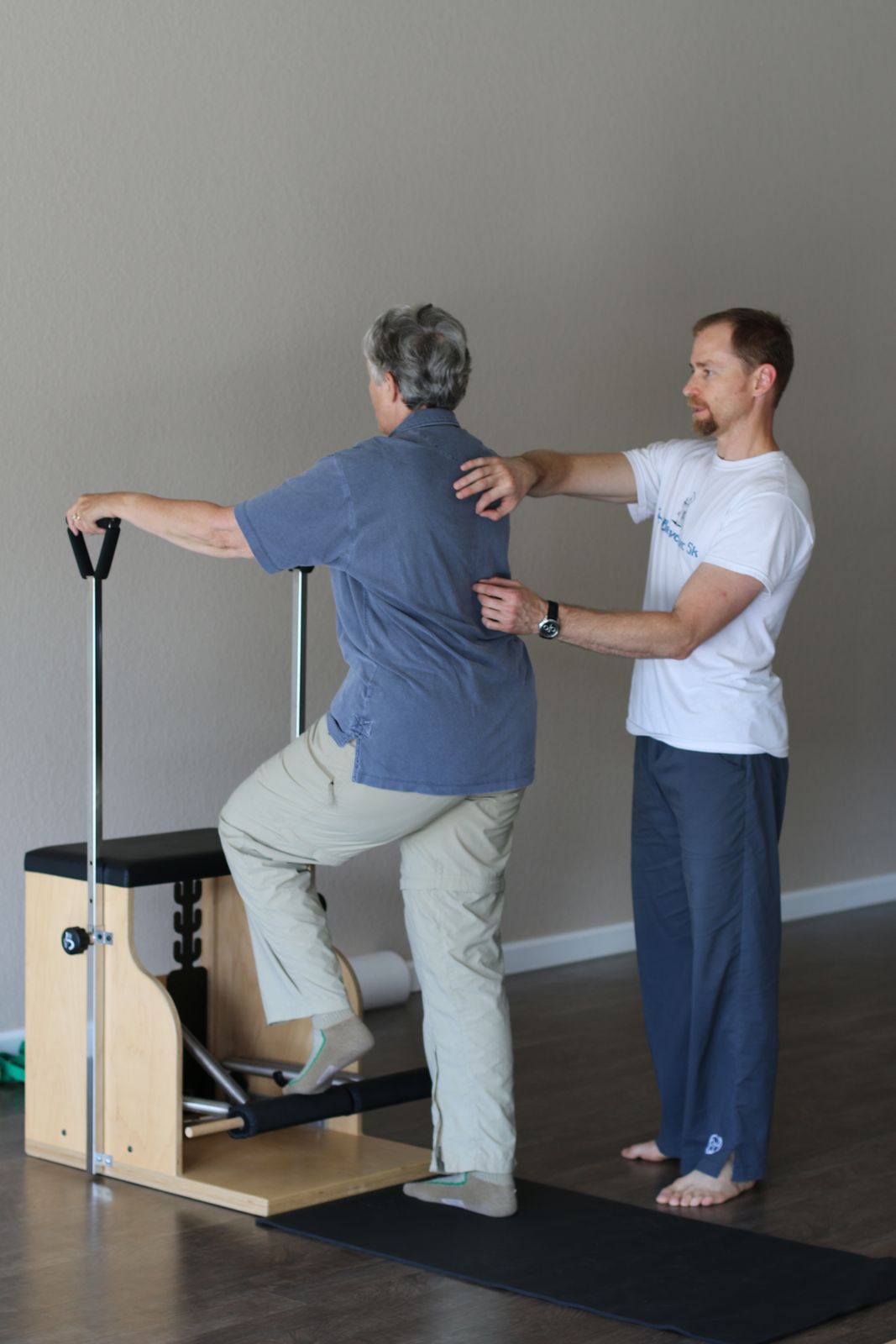
Sometimes we're exploring how someone presses through their feet during Reformer footwork.
Other times, we're observing pelvic stability during standing exercises on the Chair.
We may use the Fuse Ladder for supported standing movement or integrate functional activities that challenge weight transfer and coordination.
And sometimes, the most valuable exercise is simply learning how to stand, shift weight, and move with greater awareness.
Because balance isn't something we practice only when standing on one leg.
It's present in nearly everything we do.
Walking, reaching, carrying, bending, climbing stairs, and navigating our environment all require continuous adjustments.
Our goal is to help the body become more capable of making those adjustments.
Balance Is About Freedom
I often think about the activities that make life enjoyable.
Walking along a mountain trail.
Exploring a new city.
Playing with grandchildren.
Gardening.
Stepping into a kayak or climbing onto a bicycle.
These activities require us to interact with changing environments.
And that means our bodies need more than strength.
They need adaptability.
Balance isn't simply about preventing a fall. It's about maintaining the freedom to move confidently through the world.
And like strength, it's something we can continue developing throughout our lives.

Research & Further Reading
Sherrington C, et al. (2019).
Exercise for Preventing Falls in Older People Living in the Community.
Cochrane Database of Systematic Reviews, CD012424.
Sherrington C, et al. (2020).
Exercise for Preventing Falls in Older People Living in the Community: An Abridged Cochrane Systematic Review.
British Journal of Sports Medicine, 54(15), 885–891.
Brooke-Wavell K, et al. (2022).
Strong, Steady and Straight: UK Consensus Statement on Physical Activity and Exercise for Osteoporosis.
British Journal of Sports Medicine, 56(15), 837–846.
Abel Wellness Movement Specialists | Franklin, NC
Our individualized movement approach integrates strength, sensory awareness, coordination, and balance to help individuals develop greater confidence in everyday movement.
Educational information only. Individuals with frequent falls, dizziness, new balance problems, or significant neurological conditions should seek appropriate medical evaluation.
Patti Abel | NOV 14, 2026
Share this blog post


© 2026 Abel Wellness